032



Main
Old Updates Archive
Links
 |
Lists |
List of Pokémon
Pokémon World Atlas
List of Techniques
List
of Items
List of TV Episodes
|
Guides |
Episode
Comparisons
Movies
& Specials Guide
CD Guide
DVD Guide
Voice
Actors Guide
Lyrics Archive
Manga Guide
Video Games
|
Miscellaneous |
Humor
Pokémon Bashing
Features
Rants
Episode Stats:
Japanese Episode 032: "The Sekichiku Ninja Showdown!"American Episode 131: "The Ninja Poké-Showdown!"
Pokémon Dare Da? Konpan
Japanese Air Date: November 4th, 1997
American Air Date: October 20th, 1998
Important Characters: Aya (Aya), Kyou (Koga)
Important Places: Sekichiku Gym (Fuchsia Gym)
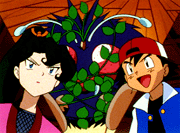
While looking for the Sekichiku Gym, Satoshi and his friends stumble across a ninja mansion! Inside, they come across a Konpan who quickly runs off, prompting our heroes to run after it. They soon discover that the mansion has a number of booby traps installed, such as invisible walls, doors leading to the side of a cliff, and flying shuriken. Eventually, they encounter a kuno'ichi named Aya. She reveals that the Konpan who had been wandering around the mansion belonged to her and then challenges Satoshi to a pokemon battle. After Satoshi's Fushigidane beats Aya's Konpan, her older brother Kyou steps forward to battle. He tells the trainer that he is the Sekichiku City Gym Leader and that the mansion they had wandered into is actually his Gym! The Rocket-Dan interrupt the battle that ensues in order to steal the Gym's pokemon and even manage to immobilize our heroes' pokemon! Kasumi's Koduck is the only pokemon left, so Kasumi attempts to use it in its first battle. After trying out a few pathetic attacks, Koduck begins to display some amazing psychic abilities! Takeshi and the others determine that Koduck's psychic abilities only come out when it has a headache The Rocket-Dan are ejected from the gym, enabling Satoshi and Kyou to resume their battle. Kyou's Golbat fights with Satoshi's Hitokage, but the bat pokemon ends up losing to the young trainer. Satoshi is able to earn himself the Pink Badge, bringing him one step closer to qualifying for the Pokémon League.
Thoughts
This episode is rare
in that it's able to cram a lot of content within its 22-minute runtime
and somehow manage to not feel rushed. In this one episode, we
get to
see Satoshi and his friends running around a ninja house, battle Aya,
and then battle Kyou. After we watch Koduck fight off the
Rocket-Dan and discover its psychic abilities,
we get to see Satoshi battle Kyou
a second time and earn his sixth badge.
That's a lot to
fit into one episode, yet it all seems to fit somehow.
The only thing
that really bugs me about this episode is how it seems to be more
about Kasumi and her duck pokemon than anything else. I feel like
people remember this episode more for establishing Koduck's psychic
powers than the battle with Kyou, and that just seems odd to me.
I love some Kasumi and Koduck stories as much as the next guy, but I
really wish they could have saved it for another episode.
It also would
have allowed the show to flesh out Kyou's character a bit better.
Because let's face it - he's one of the most boring Gym Leaders out
there. His house has
more of a personality than he does.
And what in the
world is up
with the Rocket-Dan having those weird Spider-Man web powers all of a
sudden? And then, also, Koduck has the power to melt that webbing
with its MIND? LOLWUT?
The dubbed
version, remarkably, kept the vast majority of the Japanese references
intact. I mean...they didn't have any choice, really, but it's
still nice to see them say words like "kabuki" instead of trying to
call them clowns or something. Edit-wise, this episode really
didn't fair too
poorly, something else that's really nice to see.
Golbat keeps its
Japanese voice.
Side
Note
You know about that Porygon incident, and how
the Japanese producers went back to the first thirty-seven episodes and
re-edited them? Y'know, to make any scenes with a lot of flashing
slower and less bright?
Well, 4Kids
usually gets the post-Porygon versions of these episodes
because...well, because that's just what they were given. Yet for
some reason, they got the pre-Porygon edited version of this particular episode, flashing
and all.
This is the first episode where Nathan Price's replacement, Maddie Blaustein, took over as Meowth. And, as expected, it was terrible. Absolutely awful. They hired a "sound-alike" (a term I'm using very loosely), and she didn't sound a thing like Nathan Price. Mr. Price was absolutely perfect in the role and brought nothing but love and passion to his performance. But now, 4Kids is expecting us to accept this cheap imitation and be happy! They want us to forget Meowth's true voice actor! Well I, for one, refuse to get used to Maddie's empty, soulless rendition of the character.
...
Can you imagine if people were actually like that? LOL.
Dialogue
Edit
4Kids made Misty a little bit nicer:
Misty:
"Psyduck, cold water can make a headache even worse!"
Psyduck: "Psy~?"
4Kids made Misty seem a bit more caring by having her worried about her pokemon's headache rather than being annoyed with it the way Kasumi is. And, while they were at it, 4Kids decided to go ahead and establish the fact that Psyduck even has a headache in the first place. In the Japanese version, we have no reason to think the pokemon has anything wrong with it until the second half of the episode.
Dialogue Edit
The house that our heroes go into that eventually ends up being the Sekichiku Gym is called a karakuri yashiki ("trick house") in the Japanese version. You can still find preserved karakuri yashiki in various locations in Japan that offer guided tours that explain the unique qualities of each one. If you ever find yourself in Japan for any extended period of time, I definitely recommend you check it out.
There's also a karakuri yashiki in Houen.
The English version takes to calling it a mansion, which isn't really wrong since the word yashiki can be translated as "mansion."
Later in the episode, Aya introduces herself as a kuno'ichi (くの一, or a female ninja). In the dub, she's simply referred to as a "ninja warrior."
A few lines later,
Originally, Takeshi has a pun here. His line in the Japanese version is kuno'ichi janakute, ino ichi-ban ni suteki desu ne (くの一じゃなくて、いの一番にステキですね~), which, if translated, would be "You're not a kuno'ichi; you're lovely, first and foremost (ino ichi-ban ni)." Notice how the word ichi is repeated here?
This would have been impossible to rewrite for the English version. And since there weren't any visual elements to the joke, it just got nixed and became a regular ol' line instead.
Later, during the battle:
In Japanese, the technique we call "Whirlwind" in the English versions is fuki tobashi (ふきとばし), which simply means "blow away." Satoshi isn't commanding his pokemon to use the pokemon technique of the same name; he's simply telling it to blow (it) away.
The dub kind of misinterpreted this and thought that Satoshi was telling his pokemon to use "Whirlwind" despite the fact that Bulbasaur can't learn that attack. Whoops.
Paint Edit
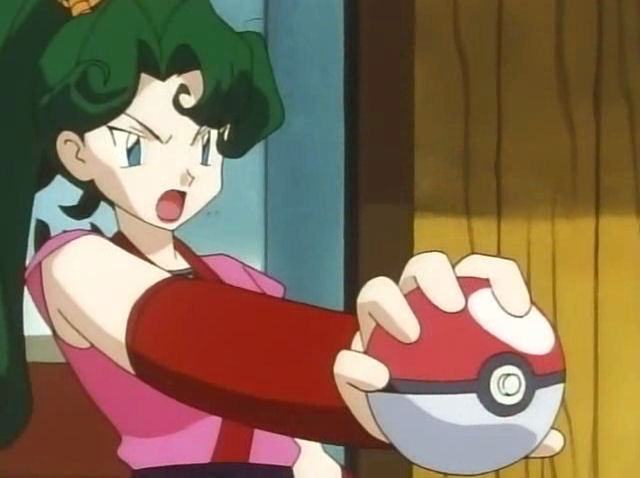
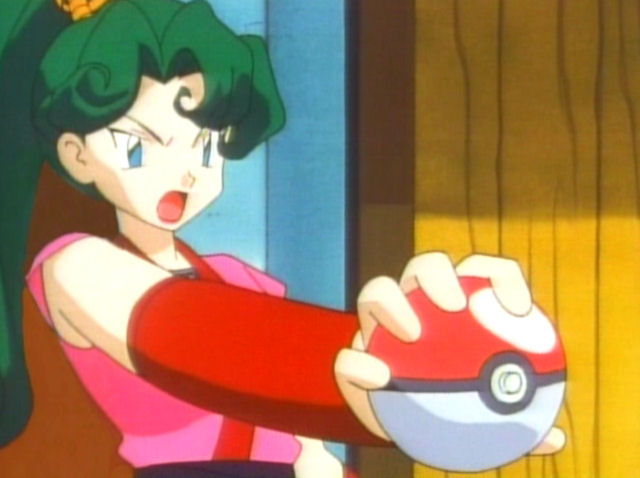
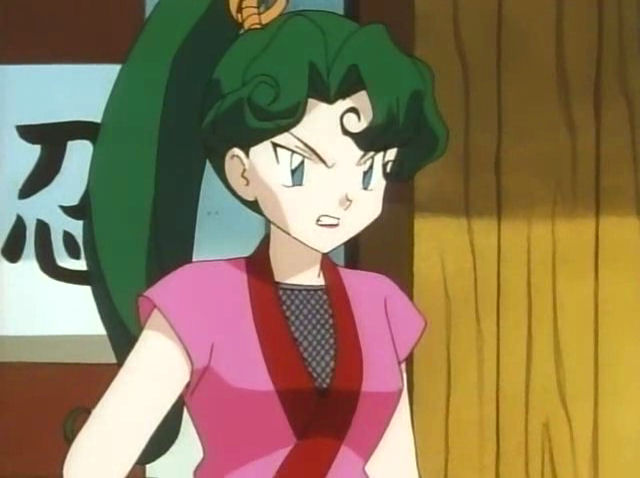
Right as Aya calls back Konpan, the kanji for nin (忍), as in ninja, got erased from the background. Despite the fact that 4Kids left in it in every other shot in the episode.
 |
 |
 |
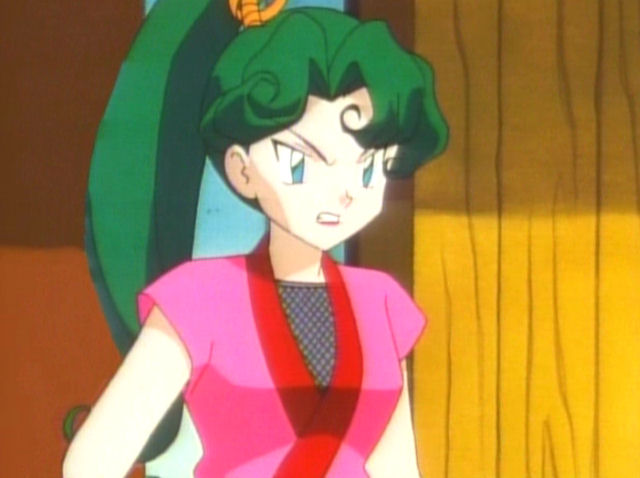 |
So what made these shots stand out so much?
Click on each image to view a larger version.
Dialogue Edit
Kyou speaks using the super formal keigo speech pattern throughout the episode, tacking things like -degozaru to the end of his sentences. The dub can't really replicate this since we don't have an equivalent in English, but they do at least try to have him speak politely when possible. Better than nothing, right?
And while I'm on the subject of Kyou; why in the world did Nintendo of America change his name in the first place? What's the point of changing one Japanese name to another? Gah!
After Kyou's introduction, there's a Rocket-Dan scene.
James: "Well, I for one am not impressed. It looks like a Japanese restaurant."
Jessie: "There are lots of precious poisonous Pokémon in that mansion."
Meowth: "Then let's figure a way to bust into this ninja joint, snatch the poison Pokémon, and hit the road!"
Jessie: "Poisonous Pokémon are positively perfect for perfidious people like us."
James: "What does that mean?"
Jessie: "It means beautiful things can be painful."
James: "Ow! That hurts!"
There's a lot going on here, so I'll just run through the list real quick. One, no James, that doesn't look like a Japanese restaurant, though kudos to you for actually saying the forbidden J-word in this series. Two, anyone who says that writers abuse alliteration in the post Season 9 era are obviously looking at the 4Kids dub with rose-colored glasses. Three, I find it funny that 4Kids is constantly dumbing things down for its audience but then goes and throws in a word like "perfidious" into one of its scripts.
Four, the Japanese equivalent of Jessie's "Poisonous Pokémon are positively bla bla bla" is a take on a quote by the author Dazai Osamu. The phrase is Fuji ni wa tsukimisou ga yoku niau (富士には月見草がよく似合う), or "The evening primrose suits Mt. Fuji," but Musashi changes it around to say "The evening primrose suits Mt. Fuji, and poison pokemon suit us villains."
Next, when Konpan evolves into Morphon,
Misty: "No, it just evolved."
In the original version, Takeshi asks if Konpan just used a kawari mi no jutsu (変わり身の術, often translated as "Art of Substitution"). That's the technique you see in ninja-themed media where the ninja vanishes in a poof of smoke and is replaced by a different object, usually a log. In Pocket Monsters Advanced Generation, Ichiko uses this technique in the Battle Frontier episode "Usohachi and the Ninja School," but you guys will probably know it better from Naruto.
Either way...Takeshi assumes that Konpan got switched out with a Morphon when they weren't looking, while Brock assumes that the pokemon transformed. It's not the biggest difference in the world, of course, but it is a difference.
The kabuki performance is left pretty much intact, something that definitely shocked the hell out of me. Rachel Lillis and Eric Stuart do a great job giving the motto that distinct kabuki-like quality, and the music is kept as well. The only things worth mentioning is that some of the set phrases used in kabuki - suru-suru-suru (するするする) and shirasaa itte kikase ya shiyou (知 らざぁ言って聞かせやしょう) - are rewritten for the dub. The Rocket-Dan's blast off at the end also replaces the saying zekkei ka na zekkei ka na (絶景かな絶景かな) with "Ah! This place looks so a lot nicer from the air!"
| Previous Episode |
Found an error or omission? Please help me keep this page current and error-free by e-mailing me with a description of the issue.

