004



Main
Old Updates Archive
Links
 |
Lists |
List of Pokémon
Pokémon World Atlas
List of Techniques
List
of Items
List of TV Episodes
|
Guides |
Episode
Comparisons
Movies
& Specials Guide
CD Guide
DVD Guide
Voice
Actors Guide
Lyrics Archive
Manga Guide
Video Games
|
Miscellaneous |
Humor
Pokémon Bashing
Features
Rants
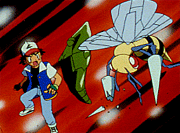
Japanese Episode 004: "The Samurai Boy's Challenge!"
American Episode 104: "Challenge of the Samurai"
Pokémon Dare Da? Trancell
Japanese Air Date: April 22nd, 1997
American Air Date: September 11th, 1998
Important Characters: Samurai (Samurai)
Important Places: Tokiwa Forest (Viridian Forest)
Satoshi and
Kasumi continue
traveling through Tokiwa Forest when Satoshi is approached
by an armored boy with a sword. The trainer, known simply as
Samurai, wants to battle Satoshi because he's from Masara Town.
Satoshi accepts. After having his Pigeon beaten by Samurai's
Kairos,
Satoshi sends his Trancell out to take care of his opponent.
Next, Samurai sends out his own Trancell to battle
Satoshi's Trancell. Since each pokemon can only use the Harden
technique, the battle isn't able to go anywhere. After a long
stalemate, a
hive of Spear appear and start chasing our heroes, causing an abrupt
end to their battle! During this
chase,
Satoshi's Trancell is taken by a Spear, but the young trainer is not
able to go back to rescue it. After a restless night spent
worrying about his pokemon, Satoshi
finds Trancell surrounded by a bunch of Spear. He grabs
his pokemon and makes a run for it, but one of the faster Spear is able
to knock the pokemon out of his hands. Satoshi is worried that
his pokemon is hurt, but when he picks it up, he notices that it's
glowing! Trancell evolves into Butterfree and uses its Sleep
Powder to knock out the bee pokemon, ending the long chase.
Satoshi asks Samurai if he wants to continue their battle, but the
young boy declines, saying that Satoshi has already displayed a better
command of pokemon than he could. Satoshi leaves the forest and
heads for Nibi City, home of his first Pokémon Gym challenge.
Thoughts
This episode is the
first "meh" episode of the series (in my opinion, of course).
While the episode breaks a lot of new ground for the series (the debut
of five different pokemon, the first "character-of-the-day," the first
appearance of a comic relief Rocket-Dan), it's still a rather dull 22
minutes. Samurai is a reeeeeally boring character, and the only
things he's remembered for is swinging a sword around and participating
in that Trancell vs. Trancell battle. Luckily, we'll get some
more interesting people show up
later down the road, but it's a shame that the first
character-of-the-day is so dull and uninteresting.
The dubbed
version is alright aside from the problems that the dub always
has. I don't like the way the dub adds an -s to the end of pokemon's names to
make them plural, but that won't last too much longer, so it's no big
deal.
Beedle and Butterfree keep their Japanese voices. Kairos doesn't have a voice in either version, and Cocoon has a voice in the Japanese version but doesn't have one in the dub.
Dialogue
Edit
Some puns just don't
translate
well...
Ash: "Maybe it's a...Cowterpie!"
Misty: "That's not funny!"
You're right, Misty, that wasn't funny.
In the Japanese version, when Kasumi's clinging on to that tree, she says "Mushi! Mushi! Mushi! ...Mushi!" which means "Bug! Bug! Bug! ...Bug!" Well, then Satoshi, in a cow costume, says "Ushi?" Ushi is the Japanese word for cow, and sounds a lot like mushi.Of course, that just doesn't translate into English at all since the words "bug" and "cow" sound nothing alike, so they had to rewrite the scene. It would have been easier for 4Kids to just cut it out, but I guess their writers like a little workout every now and then.
Side Note
The anime producers
did
a neat thing with this episode by having the battle music interrupted
in
the original. When Satoshi tries to catch the Beedle, the battle
music is playing until the next scene (the one where Samurai meets
Kasumi)
interrupts
the music. That scene plays out, and then
we cut back to Satoshi's battle and the battle music picks
up where it left off. In the dub, they just use two different
pieces
of music for each scene. This happens again later in the episode,
and 4Kids uses different music for that as well.
I really like
neat music editing things like this, so I get a bit upset whenever
4Kids changes it in the dub because they think they can do a better job
of scoring a scene than the creators.
Side Note
Look veeeerry
carefully
on Ash's sleeping bag during the scene at night. If you have a
good
copy of the episode, you'll be able to see the word "Satoshi" written
in
English letters inside a yellow box on Satoshi's sleeping bag.
4Kids' must not have caught that one.
Paint Edit
The word mika is
painted
off Musashi's cocoon at the end of the episode.
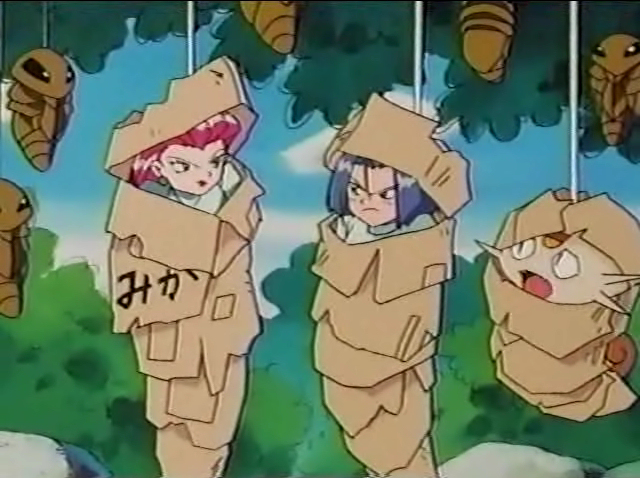
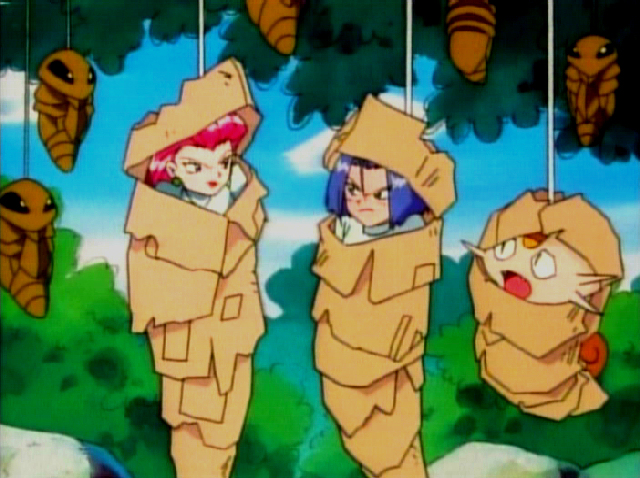
Click on each image for a larger version.
I don't know what mika is, but Reed Nelson of LupinTheThird.net e-mailed me with a theory that makes a lot of sense:| My thought is that it might have originally been a box of "みかん" (Mikan) tangerines, and the last character is just cut off (with the box being torn and all). |
It makes a lot of sense to me, so that's what I'll believe until someone provides a different explanation.
| Previous Episode |
This page was last updated on November 5th, 2016
Found an error or omission? Please help me keep this page current and error-free by e-mailing me with a description of the issue.

